


Common Mistakes in Dating Old Tower Masonry and How to Avoid Them
Few things in local history are as seductive as a date. A tower stands at the end of the street, its stones lichened and its base sunk into the pavement, and the mind wants to put a century on it before the kettle boils. That instinct is worth resisting for an hour or two. Almost every tower in a parish has been patched, re-roofed, re-windowed, re-pointed and sometimes partly rebuilt, and each of those episodes left marks that are easy to misread — especially if you are hunting for a single answer rather than a sequence. What follows are the errors that turn up most often in local notes, guidebook texts and parish pamphlets, together with the plain observational checks that keep them in bounds. None of this replaces a building archaeologist or a documentary historian. All of it will make your first reading a good deal more honest.
Treating the Whole Tower as a Single Build
A tower is not a document written in one sitting. It is a file that has been added to, sometimes clumsily, sometimes by people working two centuries apart with quite different ideas about stone. The commonest mistake is to take the base, the middle stage and the parapet as one campaign because the stone looks broadly similar, then date the whole thing from the earliest written mention of a tower on the site.
Walk the full circuit before you decide anything. Look for straight joints: vertical seams where the coursing stops dead on one side and starts again on the other. A true straight joint, running through several courses, marks a break in construction. And that is the test — not colour, not stone size, but whether the courses run through the join or are cut by it. Two different stone types can belong to the same build if the courses are bonded across the seam; identical stone can belong to two builds if the coursing is interrupted.
Then look at the plan rather than the face. A buttress that sits awkwardly against a wall, a sudden thickening near the base, a change in wall thickness at first-floor level — each suggests someone decided, at some point, that the tower needed help. Towers that lean tend to collect that kind of help.
Mistaking Repair for Original Work
Repair is the great deceiver, because it is meant to be invisible from a distance and is anything but invisible close up.
The repointing trap
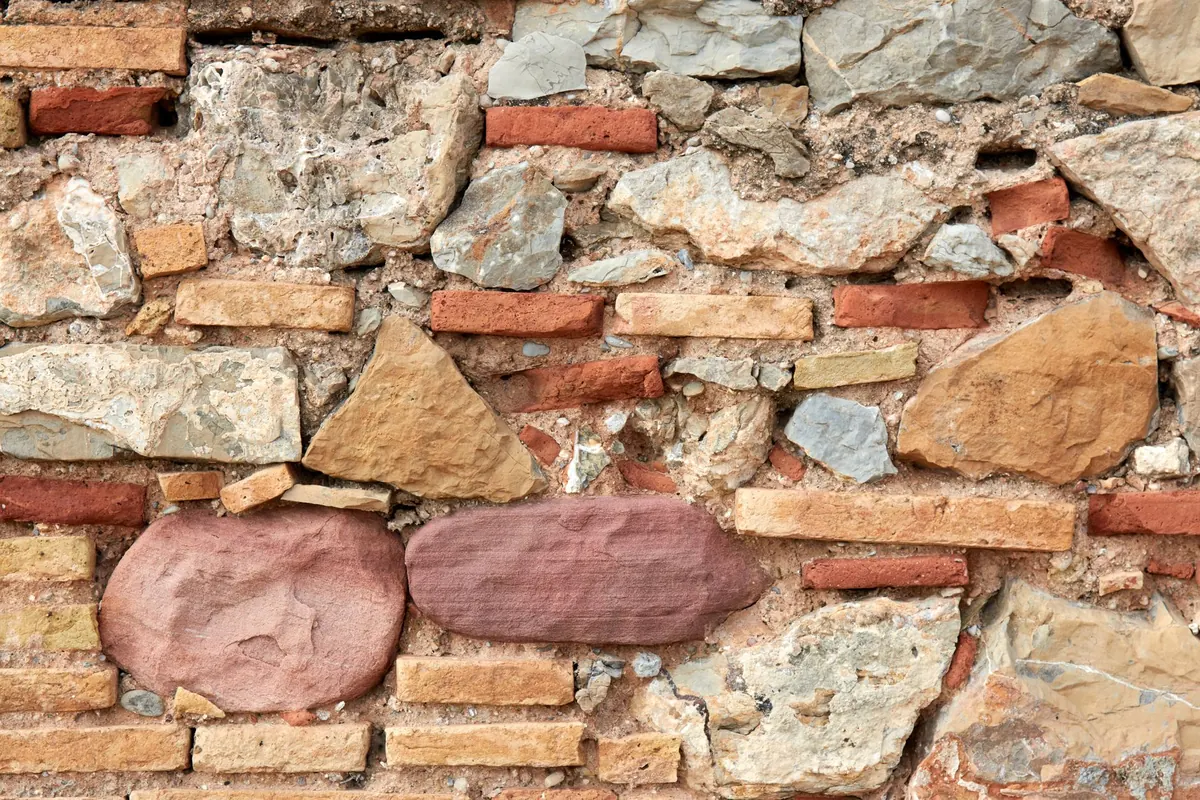
Hard, pale, cement-rich mortar in wide, flat, smeared joints reads to many eyes as "old". Often it is twentieth-century work, sometimes 1970s, occasionally last summer. Original lime mortar is usually recessed slightly behind the stone face, softer, and often a shade darker or greyer than the pointing around it. Get close — a hand's length away — and look at the back of the joint where the mortar meets the stone. If the mortar sits proud of the arris and has been brushed flat across the face, treat it as recent until proven otherwise.
Stones that stand proud
Replaced stones announce themselves in small ways: they sit a few millimetres proud of their neighbours, they carry sharper tool marks, or their bedding plane runs the wrong way. Brick patching in a rubble wall is nearly always a repair, and a lintel that looks suspiciously crisp above a doorway that is otherwise worn is usually a replacement.
- Look for stones that sit proud or slightly rotated.
- Check whether a patch's coursing matches its neighbours or fights them.
- Ask whether the mortar in a patch differs in colour, texture or depth.
- Suspect any feature that looks too tidy for its surroundings.
Reading the Surface Too Literally
Lichen is not a clock. A wall can carry a thick grey-green crust within a few decades in a damp churchyard, and a sheltered north face can stay almost bare for a century. Algae, moss and the black staining that runs down from a parapet tell you about water, not about masons.
Render and limewash are worse. A tower covered in a smooth, hard render may be hiding medieval rubble, or a nineteenth-century rebuild, or both — and the render itself may be any of those dates. Find a patch where it has fallen away, usually low down or under a sill, and read the stone there instead. The same caution applies to cleaning. A tower scrubbed back to bright stone in the last few decades will look younger than its neighbour that has never been touched, even if the neighbour is the newer building.
A date is a hypothesis about a wall, not a fact about a wall.
Ignoring the Openings and the Holes
Openings are where a tower admits what has happened to it. They are also where people stop looking, because the eye is drawn to the masonry and treats the holes as gaps in the evidence rather than as evidence itself. Take a notebook and record, face by face:
- Blocked openings. A faint straight joint and a change of infill stone often mark a doorway or window that was filled in; the infill is usually later than the wall around it.
- Inserted windows. Widened or replaced lights leave scars at the jambs and a sill that cuts across the old coursing.
- Putlog holes. Rows of square sockets at regular heights are the ghosts of scaffolding. They belong to the campaign that built that stretch of wall — very useful, and often ignored.
- Slits and gun loops. Narrow openings later widened for light tell you the wall was built before the change, not after it.
- Offsets, string courses and set-backs. A change of plane is a change of intention, and often a change of date.
Photograph each face square-on, with a scale — a metre rule or a person — and note where you stood. Six months from now, that note is worth more than the photograph.
Trusting Carved Dates and Reused Stone
A carved date is a wonderful thing and a treacherous one. It may record the completion of a tower, the gift of a bell, the restoration of a spire, or nothing more than the year a wealthy parishioner paid for a porch. A stone bearing initials and a date, set high in a wall, is frequently a reset fragment from somewhere else in the building — or from a building that no longer exists.
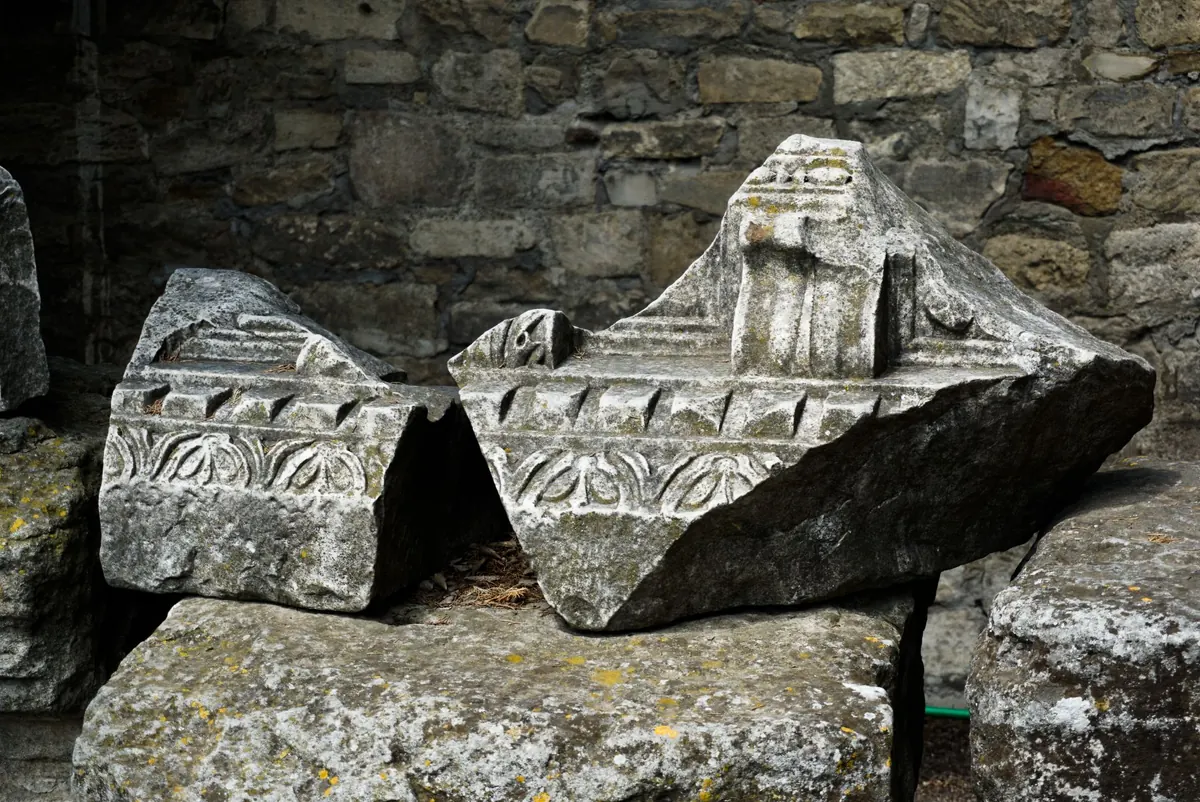
Reused stone is everywhere. Dressed blocks from a dissolved monastery, Roman tiles in a churchyard wall, a fragment of a cross shaft built into a quoin: all of it is older than the wall it sits in, and none of it dates that wall. The rule is simple enough. Reused stone gives you a terminus post quem — the wall cannot be earlier than the stone — and nothing more. A single carved detail, a mason's mark or a fragment of tracery should never carry a whole dating argument on its own.
A Short Field Routine That Keeps You Honest
Before you write a word, do the same six things every time. Walk the entire exterior, slowly, at arm's length from the wall. Sketch the elevations roughly and mark every seam, patch and blocked opening on the sketch. Note the mortar at three heights on each face. Record the openings in a list, with sizes. Photograph with a scale and a direction. Then go and read what the documentary historians have already written, and see whether your reading of the stones agrees with theirs.
When you write it up, use language that matches your evidence. "The lower stage appears earlier than the upper" is a claim you can defend from coursing. "The tower was built in 1447" is a claim you probably cannot. Give yourself room for the possibility that the next person to look will find the straight joint you missed, and write so that their discovery improves your account rather than demolishing it. That habit, more than any single test, is what separates a useful piece of local history from a confident guess.
Photo: Helmut Kaufmann / Pexels